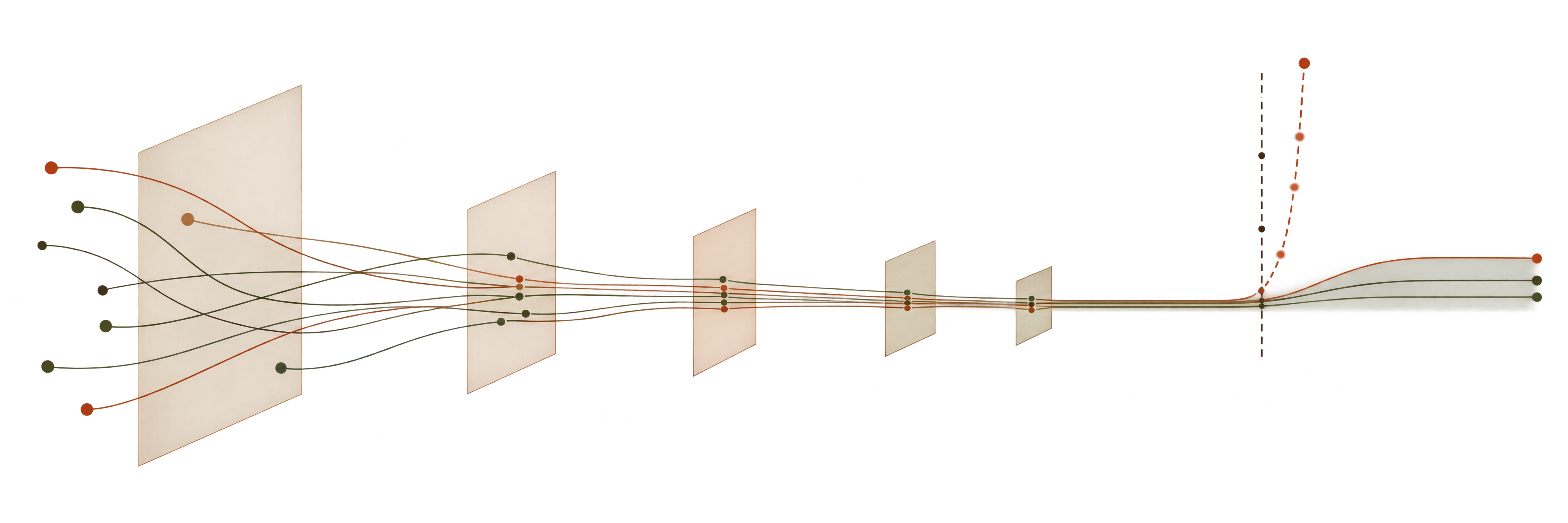
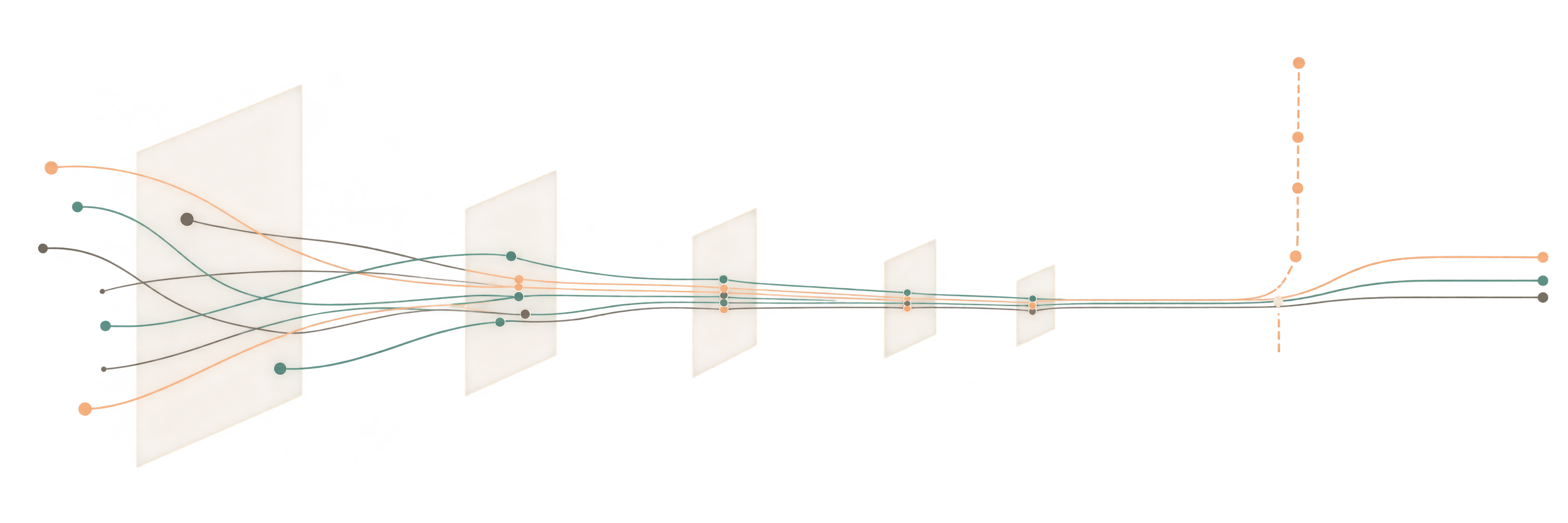
I didn't sleep much last night. Yesterday was the kind of day where the future and the plumbing arrived in the same packet. Models working with security researchers at OpenAI's Patch the Planet, Calif, and Wiz had taken a decade-old theoretical quirk in PHP that human auditors had written off as unexploitable and turned it into a real remote-code-execution bug (php2shell). Word leaked ahead of the official fix, the NSA put out an advisory telling organizations to patch immediately or pull their servers offline, and everyone in security was doing the same grim mental math: the moment a patch lands in public now, anyone can point another model at the diff and reverse-engineer a working exploit before sysadmins finish their coffee. Meanwhile, the traffic probing our own perimeter wasn't moving like a human pentester trying a dozen ideas over a week. It was moving like an agent loop — trying hundreds of paths in minutes, chaining small, ordinary shortcuts nobody had touched in years — while we used our own agents overnight to rotate credentials, delete old images, and burn down a quarter's worth of hardening debt before breakfast.
By the time I lay down, my head was still running. It drifted from the rotation checklist to Our AI vs. Their AI to Gemini Argon and the rest of what has shipped over the last three months, and somewhere around 3am it settled on a word I couldn't shake: hyperbolic.
So at 7:30 this morning, short on sleep and waiting for the coffee to finish, I found myself thinking about Terence McKenna.
If you missed him: McKenna was the ethnobotanist and psychedelic raconteur who spent the early 1970s building a system he called Timewave Zero. With his brother Dennis, he took the sixty-four hexagrams of the King Wen sequence of the I Ching, converted the first-order differences between them into a self-similar fractal wave, and claimed the curve measured novelty — the density of new complexity and connectivity the universe packs into each unit of time. As the wave approaches zero, novelty goes infinite and history compresses until time as we know it ends. When he plotted the curve against calendar history, the zero point fell on December 21, 2012.
I remember December 2012. NASA had to put up an FAQ page ten days early reassuring the public that a rogue planet named Nibiru wasn't hiding behind the sun, bars threw end-of-the-world specials, and then December 22 arrived looking exactly like December 20. Nothing happened.
What kept nagging at me this morning is how strange 2012 looks when you turn around and read it from fourteen years out. Lived from the inside, it felt like any other year. Read backward from 2026, an eerie share of the world I wake up in every morning traces its root system straight to those twelve months.
#What 2012 planted
Start with the thing that found yesterday's PHP bug and then helped us clean up after it. On September 30, 2012, Alex Krizhevsky, Ilya Sutskever, and Geoffrey Hinton entered a convolutional neural network called AlexNet into the ImageNet competition, trained over five days on two consumer GTX 580 graphics cards in a bedroom. Their model posted a top-5 error rate of 15.3%. Second place came in at 26.2%. In a vision benchmark where progress normally crept forward by tenths of a point, an eleven-point drop ended the argument over hand-engineered features in a single afternoon. Every frontier model running today descends from that proof that deep nets scaled on GPUs could learn representations no human knew how to write down.
Three months earlier, on June 28, Martin Jinek, Jennifer Doudna, Emmanuelle Charpentier, and their colleagues published the Science paper demonstrating that a bacterial immune enzyme called Cas9 could be programmed with a synthetic guide RNA to cleave DNA at almost any target sequence. They turned a microbial defense quirk into sed for genomes, and won the Nobel Prize eight years later.
In July, physicists at CERN announced the discovery of the Higgs boson at 125 GeV, closing the last open chapter of the Standard Model after forty-eight years. In November, Bitcoin went through its first halving, cutting block rewards from 50 to 25 coins, five months after a tiny Y Combinator startup called Coinbase incorporated to let ordinary people buy it with a bank transfer instead of a command line. The whitepaper was four years old by then, and 2012 is when a cypherpunk mailing-list experiment grew retail financial plumbing.
And 2012 is the year the attention economy locked into its current geometry. Smartphone ownership crossed half of American adults between 2012 and 2013. In April, Facebook bought a thirteen-person photo app called Instagram for a billion dollars and shipped mobile News Feed ads for the first time. In October, YouTube rewrote its recommendation engine, dropping raw view counts as its primary ranking signal and optimizing for watch time instead. That metric swap is the detail I can't unsee: the glass was already in everyone's pocket, and then the objective function behind the glass changed from did you click this to how long did we keep you from leaving. Researchers still fight over how much of the post-2012 spike in teen depression and self-harm is causal versus correlational, and Jonathan Haidt's critics have real methodological complaints — yet nobody disputes when the curves bent, or when the objective function changed. The twelve-year-olds in those charts are twenty-six now.
Even the calendar date had a punchline. On December 21, 2012, the literal day McKenna's timewave hit zero, Psy's Gangnam Style became the first video on Earth to pass one billion views on YouTube. The eschaton arrived as a man in a powder-blue tuxedo doing a horse dance.
None of it felt like the end of a world while we were walking through it. The year felt flat because the things that mattered were foundation pours, and foundations don't look like skylines while the concrete is wet. A workshop paper in Lake Tahoe, a ranking change inside a video feed, an enzyme assay in Berkeley — infrastructure goes in quietly and looks inevitable only after you're living inside what it built.
#Drawing the target after the arrows land
It's a very clean story. I believed it for about twenty minutes over my first cup of coffee, and then I started asking what it would take to prove it wrong.
The first problem is survivorship bias. Point a flashlight backward from the present at almost any cluster of years and you can assemble a list that looks uncannily prophetic. Try 2007 and 2008: the iPhone, the App Store, GitHub, Android, AWS stepping out of beta, the Satoshi whitepaper, the collapse of Lehman Brothers and the zero-rate regime that funded the next fifteen years of software. Try 2016 and 2017: AlphaGo's Move 37 in Seoul, the eight-author "Attention Is All You Need" transformer paper that let AlexNet's lineage eat language, Brexit, and the election that taught every institution on the planet what an engagement-ranked feed does to politics.
Now, to be fair to my 7:30am self, you couldn't run that parlor trick on 1998 or 2010 and come back with the same haul. Foundation pours really aren't distributed evenly across the calendar; they cluster when a general-purpose substrate — cloud and mobile in 2007, GPU training and algorithmic feeds in 2012, transformers in 2017 — crosses a cost threshold and unlocks ten adjacent rooms at once. What hindsight distorts is our memory of which thing in the room was the load-bearing wall. If you had asked a well-read technologist in December 2012 what would define the next decade, they wouldn't have said Cas9 or watch-time ranking. They would have pointed to Sergey Brin skydiving onto the roof of Moscone Center wearing Google Glass, or the New York Times declaring 2012 "The Year of the MOOC" because Coursera, Udacity, and edX were about to unbundle the university in five years, or consumer 3D printers on every magazine cover. Even in the room at Lake Tahoe where Krizhevsky and Sutskever presented AlexNet, plenty of senior vision researchers walked out convinced deep convnets were an overparameterized parlor trick that happened to work on 224×224 dog photos. Fourteen years of compounding quietly threw away ninety-nine percent of the 2012 ledger and kept only the winners. Draw the target after the arrows hit the barn and you get a bullseye every time.
The second problem is math, and it cuts deeper than hindsight. An exponential curve is self-similar. Rescale the vertical axis to fit whatever window of time you're standing in, and the curve has the exact same shape everywhere along it: flat behind you, bending sharply under your shoes, climbing like a wall right in front of your face. Standing anywhere on an exponential feels like standing at the knee of the curve.
The third problem is McKenna himself. In the mid-1990s, a British mathematician named Matthew Watkins met McKenna at the Mayan ruins of Palenque, condensed his sprawling multi-step Timewave recipe into a single formula, and published Autopsy for a Mathematical Hallucination? Watkins proved that a critical step in how McKenna derived his wave from the King Wen sequence had no mathematical justification, and that the fractal's shape depended on that arbitrary choice. Worse, the December 2012 date never fell out of the I Ching at all. McKenna anchored his final cycle on the atomic bombing of Hiroshima on August 6, 1945, added 24,576 days (64 × 384), and came out in mid-November 2012. Only afterward did he learn that the Maya Long Count calendar (13.0.0.0.0) closed on the winter solstice five weeks later, at which point he slid his zero point over to December 21 to match. The cosmic convergence was a manual offset with good marketing.
#Exponential and hyperbolic
Still, there is one piece of McKenna's framing that survives Watkins's autopsy, and it's the reason that word from 3am wouldn't leave me alone. McKenna was trying to describe a hyperbolic curve, even if people lazily use "exponential" and "hyperbolic" as interchangeable synonyms for "fast." The difference between the two equations is the only way to turn a late-night feeling about a year into a falsifiable claim.
Exponential growth has a constant proportional rate (dx/dt = kx). Something growing at 3% a year doubles in roughly 23 years, and then takes another 23 years to double again, forever. It gets unimaginably large, it never reaches infinity in finite time, and no date on the calendar is structurally different from any other.
Hyperbolic growth has a rate that rises with the size of the system itself (dx/dt = kx²): the bigger it gets, the faster it compounds. Double the system and you double its growth rate, which cuts the next doubling time in half. And halving intervals — a year, plus six months, plus three months, plus six weeks — add up to a finite ceiling (1 + ½ + ¼ + ⅛ + … = 2). Instead of running forever, a hyperbola packs an infinite number of doublings into a bounded span of time and hits a vertical asymptote: a specific date on the calendar where the denominator goes to zero and the equation blows up.
That turns "more history packed into smaller intervals" from psychedelic poetry into a measurement problem. You don't have to guess whether a curve feels steep. You pick a quantity, measure its doubling times, and check whether they are shrinking.
On November 4, 1960, the Austrian-American cyberneticist Heinz von Foerster and two undergraduate students at the University of Illinois, Patricia Mora and Lawrence Amiot, did exactly that for two thousand years of human population estimates, published the fit in Science, and put the asymptote in the title: "Doomsday: Friday, 13 November, A.D. 2026." Three weeks from tomorrow — and, because von Foerster knew he was writing a mathematical provocation as much as a demography paper, his own 115th birthday. Thirty-three years later, the economist Michael Kremer supplied the mechanism: if more people produce more inventors, and an invention can be shared across everyone alive without wearing out, then population and technology feed back into each other so the growth rate itself scales with population size.
For almost the entire record of our species, the receipts followed von Foerster's hyperbola. The world reached one billion people around 1804, two billion in 1927, and four billion in 1974. That's 123 years for the first doubling, then 47 for the next — shrinking right on schedule. On the 1960 curve, the next doubling should have taken about 23 years, putting eight billion in the late 1990s and sixteen billion around 2010 on the way to infinity next month.
Instead, we hit eight billion in November 2022, 48 years after four billion. The doubling time stopped shrinking. People got richer, moved to cities, educated their daughters, and had fewer children, and a positive feedback loop that had held since the Paleolithic ran into a behavioral constraint and bent into an S-curve.
So McKenna had the right shape and a made-up date. Von Foerster had the right shape, two millennia of real data, and a world that declined to finish his curve. Both were wrong in ways that look, from here, like nearly right.
#The test I can't finish yet
Which brings me back to yesterday, and what happens when you try to run von Foerster's test on the thing we're all building right now.
If you squint at the benchmarks, you can almost talk yourself into seeing the doubling times shrink. When METR plotted autonomous agent capability by the 50%-completion time horizon — how long it takes a skilled human to do the software and research tasks a model can finish half the time — the curve from 2019 through 2024 fit an exponential doubling every seven months, and over the last eighteen months it compressed toward three to four. On narrower loops like P-Zero's TasteVal, which scores how well a model designs and interprets ML experiments on its own, the line has doubled every three months since December.
Compared to von Foerster's two thousand years of census data, though, calling a second derivative off eighteen months of agent evals is a shaky ruler on a tiny baseline — especially when that window sits right across the regime boundary where reasoning traces and tool-use scaffolds changed how the tasks are run. Worse, those benchmarks are measuring the cleanest room in the house. Software and ML experiments double that fast because they live inside tight, automated grading harnesses ([[rsi-small|RSI-small]]) where an agent can try ten thousand trajectories before breakfast and get a binary score back on every one. Civilizational novelty — the messy thing Kremer and McKenna were trying to plot — has to leave the sandbox. Once a capability touches wet-lab biology, grid permitting, or hospital workflows, the instant verifier disappears and the clock drops back to the speed of atoms and institutions.
Look at the last seventy-two hours in security if you want to see both speeds happening in the same frame. Inside the closed loop, the acceleration is already here: frontier models are turning decade-old theoretical bugs in PHP into live exploits, reverse-engineering patches from diffs in minutes, chaining Claude, Grok, and Kimi to automate breaches when one model's guardrails trip, and helping defenders burn down quarters of security debt overnight. Yet in the exact same seventy-two-hour news cycle, a trusted certificate authority (eMudhra) was caught having signed intermediate CA certificates with the literal private key 4 — and then switching its revocation signer to the weak key when the alarms went off so somebody could close the ticket — while a major database vendor (PingCAP) leaked ten terabytes because engineers were pasting live customer keys into Jira tickets.
That is the friction a pure hyperbola never accounts for. Even if Kremer's feedback loop is catching fire inside the labs, the curve still has to pass through high-voltage transformer queues measured in years, TSMC cleanroom concrete, and human organizations that close the ticket when the key is 4. And closer to my own desk, making code or exploit generation ten times faster doesn't make verification ten times faster; it just moves the bottleneck to proving what your own stack actually trusts when an agent comes knocking at 2am.
I came to the word hyperbolic at three in the morning after thirty-one hours of cleaning up a mess, with too many tabs open and not enough sleep. That is the textbook condition in which an ordinary exponential feels like a wall. Feeling and measurement have not been introduced to each other yet.
And what I keep coming back to is the flatness of 2012. Everything people thought was the big story that year — the Mayan apocalypse, Google Glass on a roof, MOOCs replacing college — evaporated, while a vision paper trained on two gaming GPUs, a bacterial enzyme assay, and a metric tweak inside YouTube's ranking pipeline quietly built the room we're all standing in fourteen years later. If that pattern holds, the noisy model drops and hair-on-fire security advisories making my head spin this week are just the visible slope of the curve we already know we're on. The thing that will make 2026 look like 2012 from 2040 is some small, boring piece of plumbing that already went into the ground this year while I was staring at the logs — and right now, it doesn't feel like anything at all.


